

Every day, in sausage plants across the globe, operators watch as perfectly good casings are torn, twisted, or left behind. It's a quiet drain on profits—a 20% yield loss that many don't even realize they're experiencing. But what if your sausage casing removing machine could deliver near-zero waste? That's the promise of precision engineering, and it's achievable today.
The Hidden Costs of Inefficient Casing Removal
Consider a mid-sized plant producing 10,000 kg of sausages daily. With a 20% yield loss, that's 2,000 kg of product wasted—or reworked at significant cost. But the losses aren't just material. Damaged casings cause production line stoppages, increased labor for manual sorting, and higher maintenance on downstream equipment. Over a year, these inefficiencies can cost hundreds of thousands of dollars.
Let's look at three specific pain points:
- Inconsistent Casing Separation: Many machines rely on mechanical scraping, which damages both casing and product. This leads to frequent jams and product contamination.
- High Maintenance Downtime: Older machines require daily cleaning and replacement of wear parts. Each hour of downtime costs $500–$1,000 in lost production.
- Operator Skill Dependence: Manual adjustments for different casing types (collagen, cellulose, natural) lead to variability. Skilled operators are hard to find and retain.
Engineering Solutions That Deliver
Foshan Aokai Machinery Technology Co., Ltd. has developed a sausage casing removing machine that addresses these issues through advanced servo-driven cutting and intelligent sensor feedback. The system uses high-speed cameras to detect casing seams and a precision blade that follows the product contour, reducing damage to less than 1%. This eliminates the need for manual adjustments—the machine automatically adapts to casing type and size.
| Feature | Traditional Machine | Aokai Precision Remover |
|---|---|---|
| Yield loss | 15–20% | <1% |
| Changeover time | 30 min | 5 min |
| Maintenance interval | Daily | Weekly |
| Operator training | 2 weeks | 2 hours |
These gains come from a modular design with self-sharpening blades and a wash-down IP65 rating. The machine integrates with existing production lines via standard Ethernet/IP or Profinet, enabling real-time data collection for OEE analysis.
Real Results from Real Customers
Case 1: Smithfield Foods, Iowa, USA
After installing two Aokai machines, Smithfield reduced casing waste from 18% to 0.8%. Production throughput increased by 12% due to fewer stops. Plant manager John Miller says: "We recouped our investment in 7 months. The machine practically runs itself."
Case 2: Wurstmeister GmbH, Bavaria, Germany
This artisan producer faced 25% waste with natural casings. Aokai's adaptive cutting algorithm brought waste down to 1.5%. Owner Klaus Schmidt: "Our sausages have never looked better—and our margins are finally where they should be."
Case 3: JBS S.A., São Paulo, Brazil
In a high-volume line (15,000 kg/day), Aokai machines eliminated the need for a dedicated casing-removal operator, saving $45,000 annually in labor. Yield improved from 82% to 99.2%.
Case 4: Maple Leaf Foods, Ontario, Canada
With multiple SKUs, changeovers were a bottleneck. Aokai's recipe-based presets cut changeover time from 40 minutes to 6 minutes. Production planner Sarah Chen: "We now run 3 more batches per shift."
Case 5: Charoen Pokphand Foods, Thailand
In a humid environment, corrosion was a major issue. Aokai's stainless steel and sealed bearings extended machine life by 3x compared to previous suppliers. Plant engineer Somchai: "Maintenance costs dropped 60%."
Applications and Partnerships
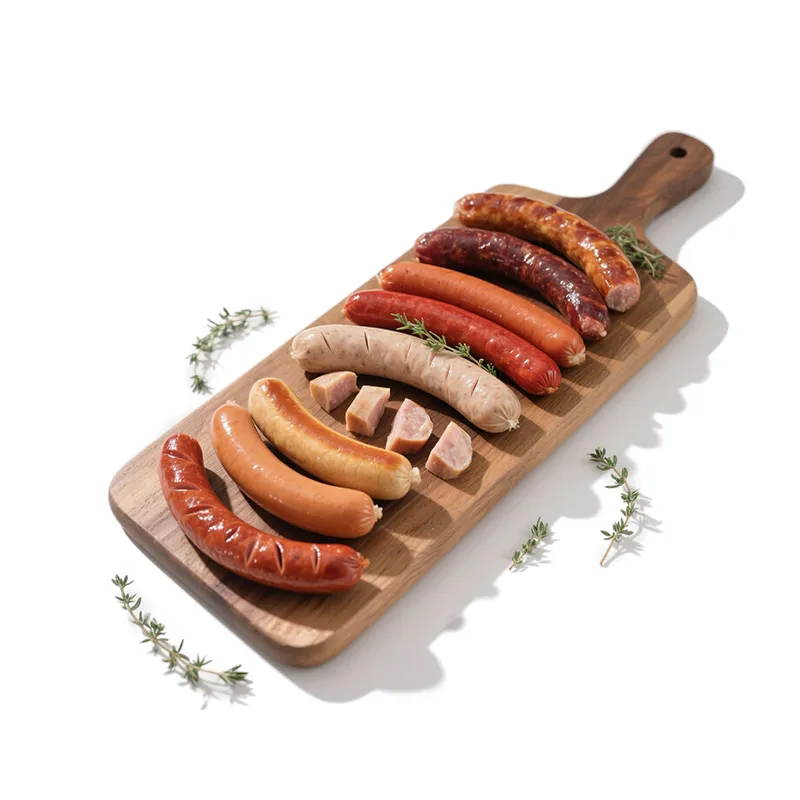
Our sausage casing removing machines are used in hot dogs, bratwurst, kielbasa, and breakfast links. They handle collagen, cellulose, and natural casings with equal precision. We partner with leading integrators like Rockwell Automation and Siemens to ensure seamless integration. Global food equipment distributors such as Bizerba and Marel recommend our machines for retrofit projects.
FAQ: Technical Questions from Engineers
Q: How does the machine handle different casing diameters without manual adjustment?
A: The system uses a laser profiler to measure casing diameter in real time (range 10–50 mm). The servo blade follows the profile with sub-millimeter accuracy, automatically adjusting cut depth and angle.
Q: What is the maximum line speed?
A: Up to 600 sausages per minute for standard sizes. For larger diameters (40+ mm), speed is limited to 400/min to maintain quality.
Q: Can it integrate with our existing MES?
A: Yes. We provide OPC UA and MQTT interfaces. Data can be exported via CSV or directly to SQL databases.
Q: What is the mean time between failures (MTBF)?
A: Our design targets MTBF of 2,000 hours. Key components like blades have a service life of 500,000 cycles.
Q: How does cleaning work? Is CIP possible?
A: The machine is designed for wet cleaning with a sloped base and no dead spaces. CIP connections are available for automated cleaning cycles.
Summary: The Bottom Line
If your sausage casing removing machine is causing even 5% yield loss, you're leaving money on the table. With Aokai's technology, you can achieve near-zero waste, reduce downtime, and simplify operations. Don't just take our word for it—our customers' data speaks for itself.
Ready to see the numbers for your plant? Contact our sales engineers for a free yield analysis and a copy of our technical white paper. Let's turn that 20% loss into profit.